Tecan Freedom EVO-2 100 Liquid Handler 10541100

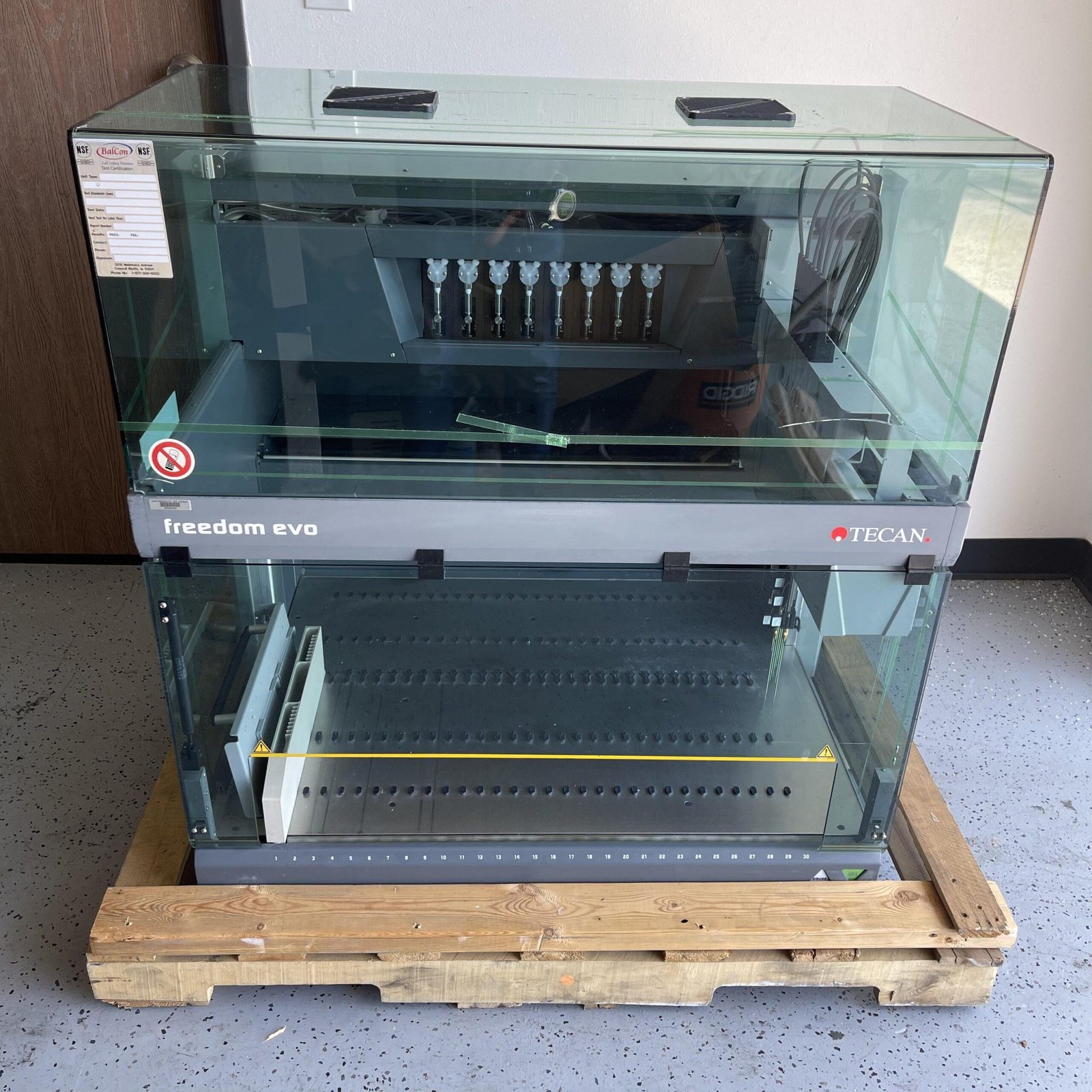
The Tecan Freedom EVO-2 100 (Base Part Number: 10541100) is a highly reliable, compact open-architecture liquid handling platform designed for small-to-medium throughput laboratories. Positioned as the mid-sized footprint in Tecan’s established Freedom EVO series, the EVO-100 balances deck capacity with space efficiency, making it a staple for automated sample preparation, assay setup, and biochemical screening.
Tecan Freedom EVO-2 100 Specifications & Architecture
- Footprint & Deck Size: The EVO 100 offers a 100 cm wide deck. Therefore, it provides approximately 27 grid positions for microplates, tip racks, reagent carriers, and wash stations.
- Dynamic Arm Configuration: The system typically supports up to two independent robotic arms. Most commonly, it is configured with a Liquid Handling Arm (LiHa) and a Robotic Manipulator Arm (RoMa).
- Pipetting Technology: It is available in both air-displacement and liquid-filled displacement configurations. Furthermore, it accommodates disposable tips or washable fixed steel tips to match chemical compatibility requirements.
Core Applications of the Tecan Freedom EVO-2 100
Because the Freedom EVO platform operates on an open-layout design, it can be tailored to a vast array of life science workflows:
Genomics: Automated DNA/RNA extraction, PCR and qPCR setup, next-generation sequencing (NGS) library preparation, and magnetic bead-based purifications.
Cell Biology & Screening: Microplate replication, serial dilutions, compound hit picking, and cell culture maintenance (when integrated with a laminar flow hood).
Analytical Chemistry: Sample dilution series, solid-phase extraction (SPE) setup, and aliquoting for LC-MS or HPLC analytics.
System Modularity and Upgradability
Designed on an open-architecture framework, the Tecan Freedom EVO-2 100 allows for hardware modifications and module integration to match evolving laboratory protocols. The base platform can be expanded by adding secondary arms—such as the Robotic Manipulator Arm (RoMa) for microplate transport—or by integrating external peripherals beneath the deck surface. Supported hardware options include automated thermal cyclers, barcode readers, vacuum manifolds, and magnetic separation blocks, enabling users to transition from basic liquid dispensing to fully automated multi-step workflows.
Expert Technical Advantages
1. True Walkaway Integration
Unlike entry-level pipetters, the EVO-2 series excels at integrating peripheral hardware. For instance, the deck structure allows seamless undersurface mounting of orbital shakers, vacuum manifolds, magnetic blocks, and incubators. As a result, this enables full assay automation from raw sample to final read without manual intervention.
2. Process Safety and Liquid Detection
The platform utilizes sophisticated Capacitive Liquid Level Detection (cLLD) and Pressure-based Liquid Level Detection (pLLD). First, this dual-sensing mechanism minimizes tip immersion depth to reduce carryover contamination. Moreover, it flags errors such as clogged tips, empty reagent vessels, or foam detection in real-time.
3. EVOWare Software Flexibility
Controlled via Freedom EVOware, the system offers precise script customization. Experienced automation engineers can map intricate liquid classes (adjusting aspiration speeds, blowout volumes, and settling times) to successfully handle challenging pipetting matrices, such as viscous glycerol stocks, volatile solvents, or foaming detergents.
In summary, the Tecan Freedom EVO-2 100 is a versatile, open-architecture liquid handler ideal for small-to-medium labs. Powered by seamless hardware integration, advanced liquid sensing, and customizable EVOWare software, it easily handles demanding workflows from genomics to analytical chemistry.