
Temperature Control Unit – Agilent PCB-1500 Water Peltier System

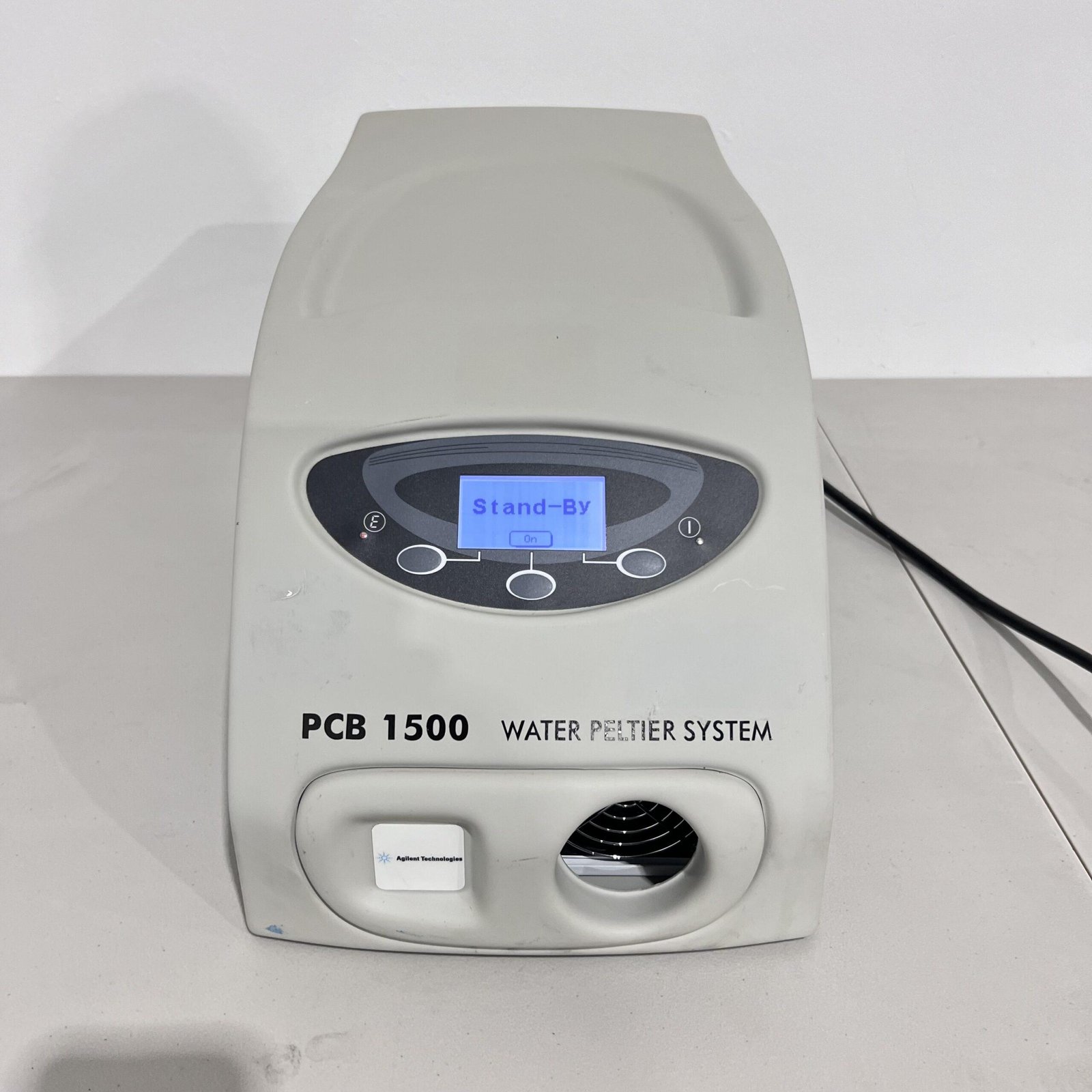
The Agilent Technologies PCB-1500 Water Peltier System is a high-precision temperature control unit. Laboratories use this unit for applications requiring stable thermal regulation. Engineered to integrate seamlessly with spectrophotometers and optical measurement instruments, the PCB-1500 utilizes solid-state Peltier thermoelectric technology. Combined with water cooling, it delivers reliable, precise temperature management during sensitive sample analyses. Additionally, its robust engineering ensures long-term stability in demanding research environments.
Key Features & Technical Specifications of the Temperature Control Unit
- Peltier-Based Thermoelectric Cooling: Solid-state Peltier elements enable rapid thermal response and accurate temperature holding. Consequently, operators avoid the noise, bulk, and vibrations of compressor-based refrigeration systems.
- Water-Assisted Heat Dissipation: An external water circulation loop efficiently dissipates excess heat. As a result, the unit maintains stable target temperatures even during extended operational runs.
- Compact Footprint: A space-saving benchtop design easily fits alongside primary analytical equipment without occupying excessive laboratory space.
- Digital Display & Control Interface: A front-panel digital LED readout and tactile control buttons allow operators to monitor actual versus setpoint temperatures in real time.
- Versatile Integration: Designed for spectroscopic accessories like multi-cell transport systems and cuvette holders. Thus, it delivers essential temperature control for repeatable kinetics and quantitative testing.
Primary Applications for the Temperature Control Unit
Researchers across academic, pharmaceutical, and industrial settings use the PCB-1500 Water Peltier System for critical testing protocols:
- UV-Vis Spectrophotometry: Maintaining uniform cuvette temperatures prevents thermal gradients from affecting absorbance readings.
- Enzyme Kinetics Studies: Steady thermal environments allow precise evaluation of temperature-dependent enzymatic reaction rates and protein denaturation. Furthermore, researchers rely on it for consistent heat transfer.
- Chemical & Material Characterization: Controlling sample conditions ensures accurate thermal stability testing, polymer evaluation, and quality control procedures.
- Biotechnology Research: Supporting nucleic acid melting curve experiments and thermal denaturation assays.
Operational & Maintenance Considerations for the Temperature Control Unit
- Fluid Maintenance: Operators should routinely inspect water circulation lines and cooling fluid levels to ensure proper heat exchange efficiency and prevent line blockages.
- Vibration-Free Operation: Because solid-state Peltier devices lack moving compressor parts, the unit operates quietly. Therefore, it minimizes mechanical vibration to protect sensitive optical alignments.
- Benchtop Setup: Positioning the unit with adequate clearance around cooling vents guarantees unobstructed airflow and optimal heat dissipation during continuous operation.
In conclusion, the Agilent Technologies PCB-1500 Water Peltier System temperature control unit remains a dependable thermal regulation solution for laboratories seeking precise, repeatable spectrophotometric workflows.
.